
Artist: Addison Karl (website, Instagram)
Location: 2nd & Blanchard
Mural Description
Painted during the Belltown Mural Festival 2024.
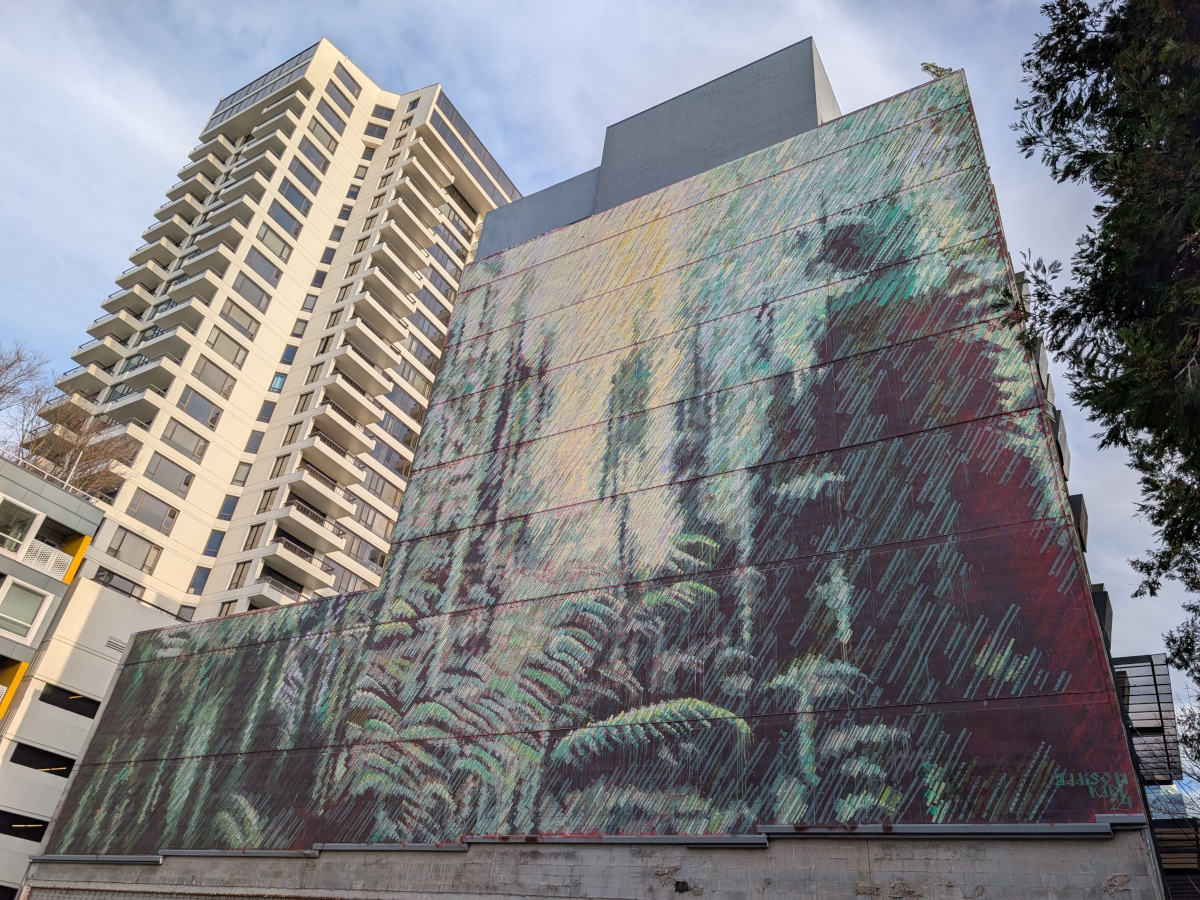
Look up on Second Avenue and you’ll find one of the most ambitious works in the entire Belltown Mural Festival: Biomass by Addison Karl, a monumental acrylic painting measuring 77 feet high by 106 feet wide — covering the full face of a seven-story building that was, until recently, just a drab gray wall.
A dense canopy of ferns, contrasting light penetrating foliage, and the shadowed outlines of soaring trees fill the composition, painted line by line using impressionistic hatch-lines — every single mark made by hand with a roller, across 19 layers of paint, over eight days. No spray. No shortcuts.
The idea behind the work is deeply rooted in Seattle itself. Addison describes Biomass as a dialogue between the natural and the artificial — the unprocessed and the processed — exploring the way Seattle, for all its concrete and glass, remains fundamentally tied to something older and wilder than itself. The Pacific Northwest rainforest didn’t disappear when the city was built; it persists in memory, in the landscape just beyond the skyline, and now, in this wall.
The piece is ultimately a joyous celebration of art’s power to record, mirror, and bring back to life the things that matter most to a community. Standing in front of it, that feels exactly right.
Addison was a local Seattle artist who has since moved to Italy.
Because he no longer lives locally, the mural was deliberately not taken all the way to the ground, since touch-ups would be impossible.
Artist Statement
Underneath the cacophony of contemporary life, Seattle is a site where the old heartbeat of nature continues to beat. In my own little manner, I aimed to record, maintain, and enhance this place’s memory of what once was with “Biomass.” Despite moments when it appears like it’s about to forget itself, it clings tenaciously to the memory of what was.
The piece, if I may use that term, is more of a dialogue between the natural and the artificial, the unprocessed and the processed, the constructed and the state-of-being. As if nature were to pick up a brush and insist on highlighting its own resiliency and beauty. Those energetic, pulsating hatch-lines that move over the canvas are more than just lines; they are the reverberations of ferns rustling in the chilly, wet air and the gentle swaying of tree shadows in a wind that seemed to bear the burden of ages. The skyline rises higher and higher, either challenging or maybe paying tribute to the old rhythms that still rule this land; each line is a gesture in this regard.
My conscious mind was overridden by something more primal and ancient as I painted, and I sank into the negotiation, becoming an integral part of it. The purposeful and intuitive hatch-lines that run across the canvas symbolize the dichotomy that distinguishes this location. The markings of a mind that is enchanted by the order of city planning and enchanted by nature’s disorder, a mind that finds beauty in both worlds but finds it difficult to find a way to reconcile them.
However, “Biomass” is more than just a piece of art. In addition to being a love letter, it poses questions, issues challenges, and invites readers to contemplate what our lives may be like if we took the time to observe and comprehend the world around us. The city, with all its modernity and advancement, is fundamentally tied to something bigger, older, and more powerful than itself; this is something to keep in mind. Additionally, it is an invitation to value that connection, cultivate it, and allow it to guide and inspire our construction, life, and dreaming.
More than simply Seattle is included in “Biomass” in the end. Alluding to the manner in which both humans and the environment influence one another, it explores the interplay between the two. In it, we ruminate on the delicate nature of that bond and the need of finding a middle ground if we want to live in harmony with nature. Additionally, it is primarily a joyous commemoration of the ability of art to record, mirror, alter, and bring back to life the things that are really important to us.
Addison Karl bio from Belltown Mural Festival:
Addison’s emerges as a fervent visual artist deeply connected to his Chickasaw and Choctaw heritage. Born in Denver and immersed in the arid splendor of Phoenix, Arizona, Addison’s artistic trajectory is a testimony to his enduring quest to produce work that strikes a chord with museums, galleries, and collectors internationally. He briefly studied Fine Arts at the Art Institute, before ultimately choosing to leave the formal academic setting in pursuit of his own creative path. This decision led him to explore screen printing, a medium he had initially encountered in high school art classes and embraced for its process. This formative experience enabled him to sharpen his skills and cultivate his understanding of drawing and the creative process, paving the way for the unfolding of his artistic journey.
Map (see murals near me) / Belltown Murals general information